You turn the key or press the start button and instead of the engine firing up, you hear clicking. Maybe it's a fast chatter, maybe it's one solid clunk, maybe the dash lights flicker along with it. Either way, the car isn't going anywhere.
The good news is that the sound itself tells you a lot. Different clicks point to different parts of the starting system, and a few minutes of observation can save you from replacing the wrong part. Here's how to decode what you're hearing.
How the Starting System Works, in Plain Terms
When you turn the key, a small signal goes to the starter solenoid, an electromagnetic switch mounted on or near the starter motor. The solenoid does two jobs: it pushes the starter gear into the engine's flywheel and closes a heavy-duty contact that sends battery current to the starter motor. The motor then spins the engine until it fires.
The click you hear is the solenoid moving. If everything downstream works, the click is followed instantly by the whir of the starter and the engine catching. When something is wrong, you get the click without the crank. What kind of click tells you where the problem is.
Rapid Clicking: Almost Always a Weak or Dead Battery
A fast click-click-click-click while you hold the key is the most common version, and it nearly always means low battery voltage. There's enough power to pull the solenoid in, but when the starter tries to draw its heavy current, voltage collapses. The solenoid drops out, voltage recovers, it pulls in again, and the cycle repeats rapidly.
Typical causes:
- A battery that's worn out, which is common after two to four years in Florida heat
- A healthy battery that was drained by a light, an open door, or a car that sat too long
- Corroded or loose battery terminals that can't pass enough current
Dim or flickering dash lights during the clicking strengthen the battery diagnosis. A jump usually gets the car started, but whether you need a new battery is a separate question. Our guide to jump start vs battery replacement helps you decide, and our list of signs your car battery is dying covers the warnings that usually come first.
One Loud Click, Then Nothing
A single solid click with no crank, while the lights stay bright, points away from the battery and toward the starter circuit. Common culprits:
- A failing starter motor whose internal contacts or brushes are worn
- A bad solenoid that clicks but doesn't close the high-current contact
- A loose or corroded cable at the starter or battery, especially the main ground
- Occasionally, a mechanical problem that keeps the engine from turning
The lights are the key clue. If they stay bright when you hear the single click, the battery is probably delivering, but the current isn't reaching or being used by the starter. If they dim hard, the battery is still a suspect. We test the battery and connections first. If the starter is at fault, we tell you what we found and refer you to a repair shop, since we don't replace starters.
No Click at All
Silence with no click and no crank can mean several things:
- A completely dead battery, where even the dash stays dark
- A transmission not fully in Park or Neutral, which blocks the start circuit
- A blown fuse or failed starter relay
- A key fob with a dead battery on push-button cars, or a security system that isn't recognizing the key
- A failed ignition switch or neutral safety switch
Try shifting firmly into Park, or into Neutral and back. On push-button cars, hold the fob directly against the start button, since many cars can read a weak fob that way.
If the dash is completely dark, check whether the battery cables are still attached firmly. A clamp that has loosened over time can lose contact completely, and it looks exactly like a dead battery. A battery that went flat over a long trip away from home, common for cars left at the airport or a cruise port lot, can also drop so low that nothing lights up. In those cases a jump or a charge brings the car back, and a test afterward shows whether the battery survived the deep discharge.
Corroded Terminals: A Common Tampa Bay Culprit
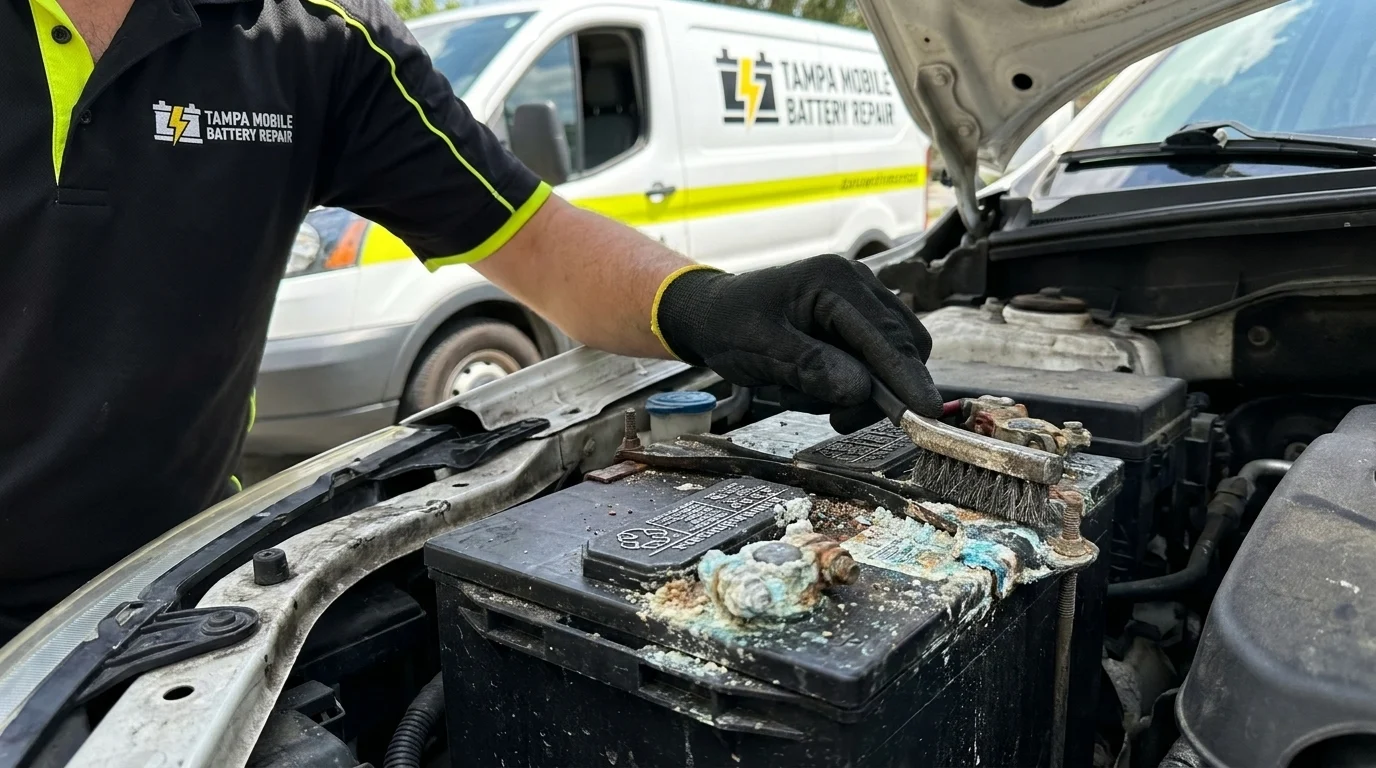
Humidity, heat, and salt air near the bay make terminal corrosion a regular issue here. That white or blue-green crust on the posts is a poor conductor. A battery can be perfectly healthy and still produce rapid clicking because the current can't get through the buildup.
If you see corrosion, don't scrape it with bare hands; it's acidic. Cleaning the terminals, treating them with a protective coating, and replacing damaged clamp ends often restores a solid start. Our battery terminal cleaning service handles it on-site, and if a clamp is too far gone, we can replace the terminal end right there. We see this a lot on work trucks around Plant City and on cars parked outside near the Hillsborough River in Temple Terrace.
What to Do Next When Your Car Clicks in Tampa
Before calling anyone, try these quick checks:
- Turn on the headlights and watch them while you try to start. Big dimming means battery or connection; bright lights point toward the starter.
- Look at the battery terminals for corrosion or a clamp you can wiggle by hand.
- Make sure the shifter is fully in Park.
- Wait a minute and try again; repeated rapid attempts can drain a weak battery further.
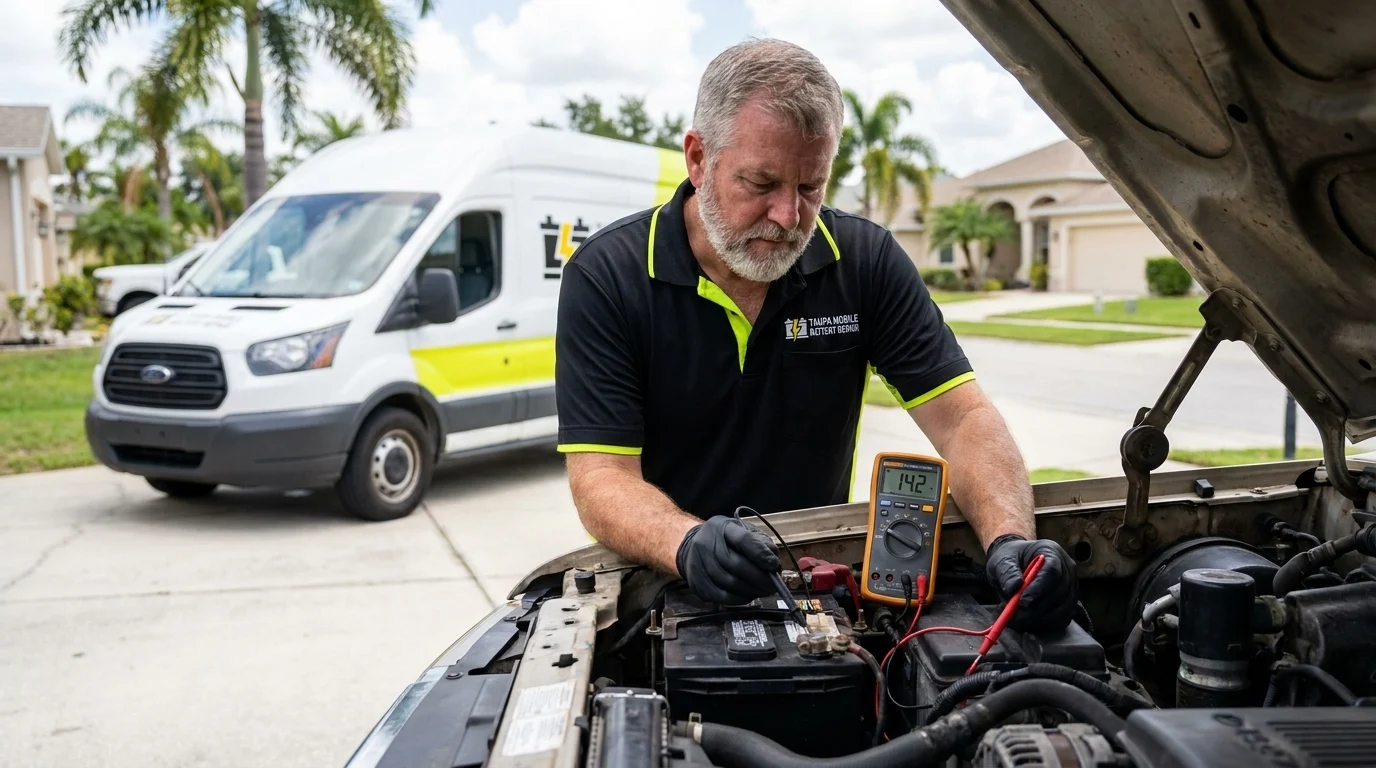
If the clicking continues, the fastest path is a proper diagnosis where the car sits. A jump start answers the battery question in seconds, a battery test tells you whether it's worth keeping, and an alternator and charging-system test confirms the car will keep the new charge once it runs. A healthy charging system usually shows roughly 13.8 to 14.7 volts at the battery with the engine running.
That last step matters. If the battery died because the alternator isn't charging, a jump or even a new battery will only buy a short time. Read more in can a bad alternator drain a battery. Whether you're stuck in a driveway in Land O' Lakes or a parking lot off Fowler Avenue, the same sound-based logic will point you to the right fix.