Most car batteries don't go from perfect to dead overnight. They fade, and the car usually drops hints for days or weeks before the morning it won't start. The trouble is that those hints are easy to explain away: the engine was just a little slow, the lights were just a little dim, it was just the heat.
In Tampa Bay, where heat wears batteries down in two to four years, it pays to know what those hints look like. Below are the eight signs we see most often, what's actually behind each one, and how to tell a dying battery from an alternator or connection problem that looks similar.
1. A Slow, Labored Crank
This is the classic early warning. Instead of a quick, crisp start, the engine turns over with a drawn-out rrr-rrr-rrr before it catches. It's often worst first thing in the morning or after the car has been parked for a few hours at work.
A slow crank means the battery can't deliver its full current anymore. Internal wear, sulfation, or a partially discharged state all reduce what the battery can push to the starter. If it's happening consistently, the battery is telling you it's near the end. Don't wait for it to become a no-start in the middle of a busy day.
Pay attention to when the slow crank happens. If it only shows up after the car has sat for several days, the battery may be healthy but slowly drained by something that stays on. If it happens even after a long drive on the Selmon or I-75, the battery itself is the more likely problem. That distinction helps whoever tests it narrow things down faster.
2 and 3. Clicking When You Turn the Key, and Flickering Dash Lights
A rapid clicking or chattering sound with no crank usually means the battery has enough voltage to engage the starter solenoid but not enough to actually spin the engine. The solenoid pulls in, voltage collapses, it lets go, and the cycle repeats quickly.
You may also notice the dash lights flicker, dim sharply, or the gauges do a strange sweep when you try to start. That's the same voltage collapse showing up on the instrument cluster.
A single loud click with no crank is a different story and can point to the starter or a bad connection. We cover the different sounds in detail in our guide to a car that won't start with a clicking noise.
4. Dim Headlights and Odd Electrical Glitches
Headlights that look yellow or weak at idle and brighten when you rev the engine, power windows that move slower than usual, or a radio that resets its clock are all signs of low system voltage. Modern cars are also sensitive to weak batteries in less obvious ways. You might see random warning lights, a stop-start feature that quits working, or a keyless entry system that acts up.
These symptoms can come from a weak battery, but they can also come from an alternator that isn't charging properly. That's why testing both together matters.

5. The Battery or Charging Warning Light
The little battery-shaped light on your dash is technically a charging-system warning. It comes on when the car's computer sees voltage outside the normal range while the engine is running. That can mean a failing battery, but it's just as likely to be a weak alternator, a slipping belt, or a bad connection.
If that light stays on while you're driving, take it seriously. The car may be running on battery power alone and could shut down once the battery is drained. Get the charging system checked before replacing anything; an alternator and charging-system test tells you which part is at fault.
6 and 7. Swelling, Leaks, Corrosion, or a Rotten-Egg Smell
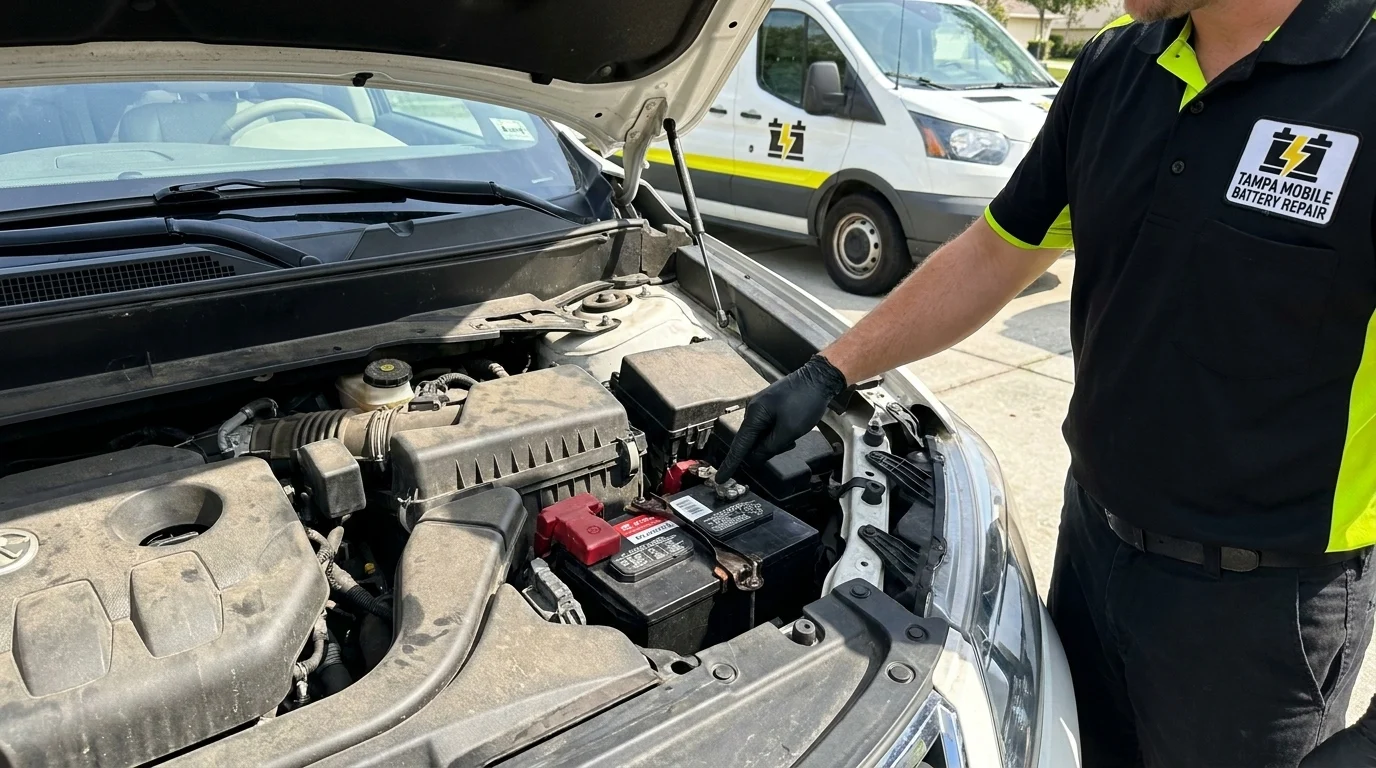
Some signs you can see or smell when you open the hood:
- A swollen or bulging case. Extreme heat or overcharging can warp the battery case. A bloated battery should be replaced, period.
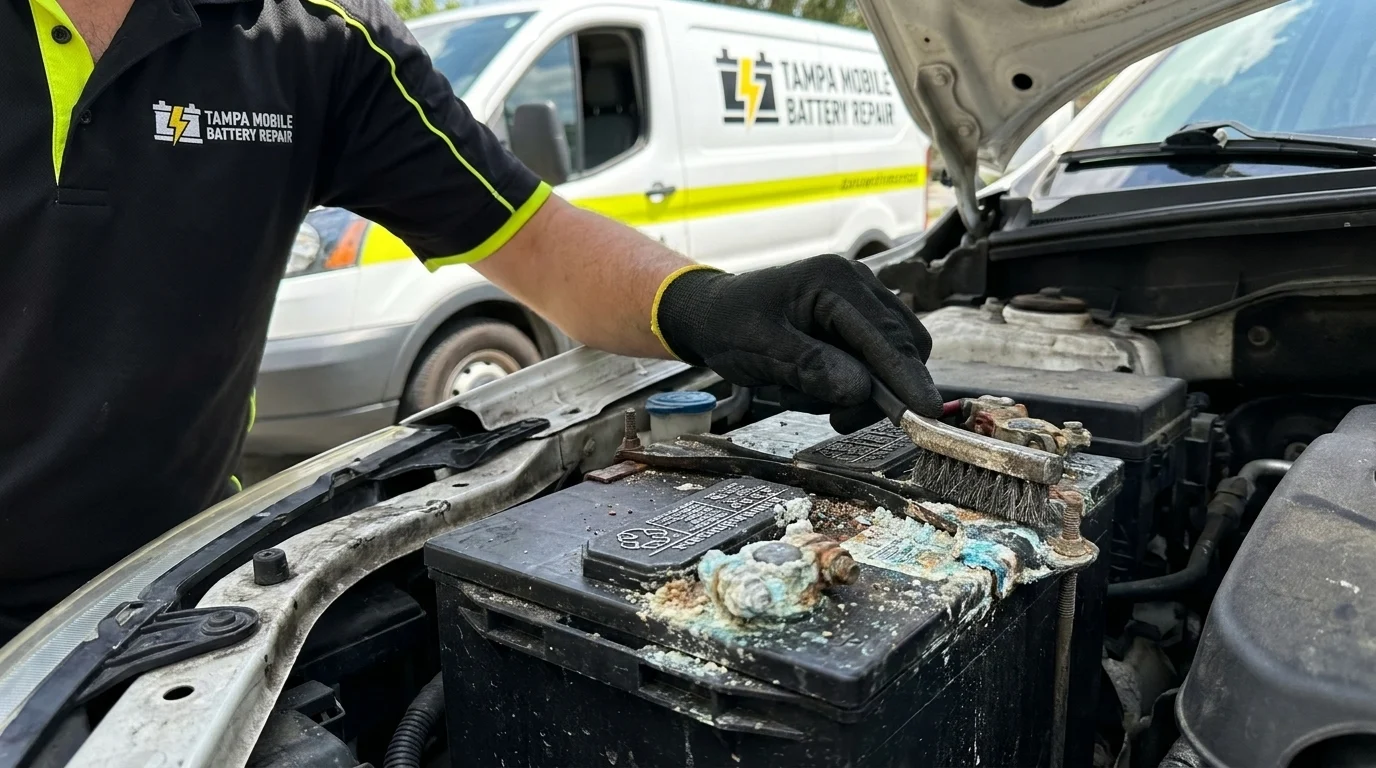
- Heavy corrosion on the terminals. White, blue, or green crust around the posts increases resistance and can mimic a dying battery. Sometimes cleaning solves the problem; sometimes it's a sign the battery is venting or leaking.
- A sulfur or rotten-egg smell. That odor points to a battery that's overheating or leaking acid, often because it's being overcharged or has an internal short. Don't lean over it; have it looked at promptly.
- Wet residue around the case. Any leaking acid is a reason to replace the battery and clean the tray.
Light corrosion is common in humid Tampa Bay, especially closer to the water. If the battery itself is healthy, a terminal cleaning may be all you need.
8. Age Plus Repeated Jump Starts
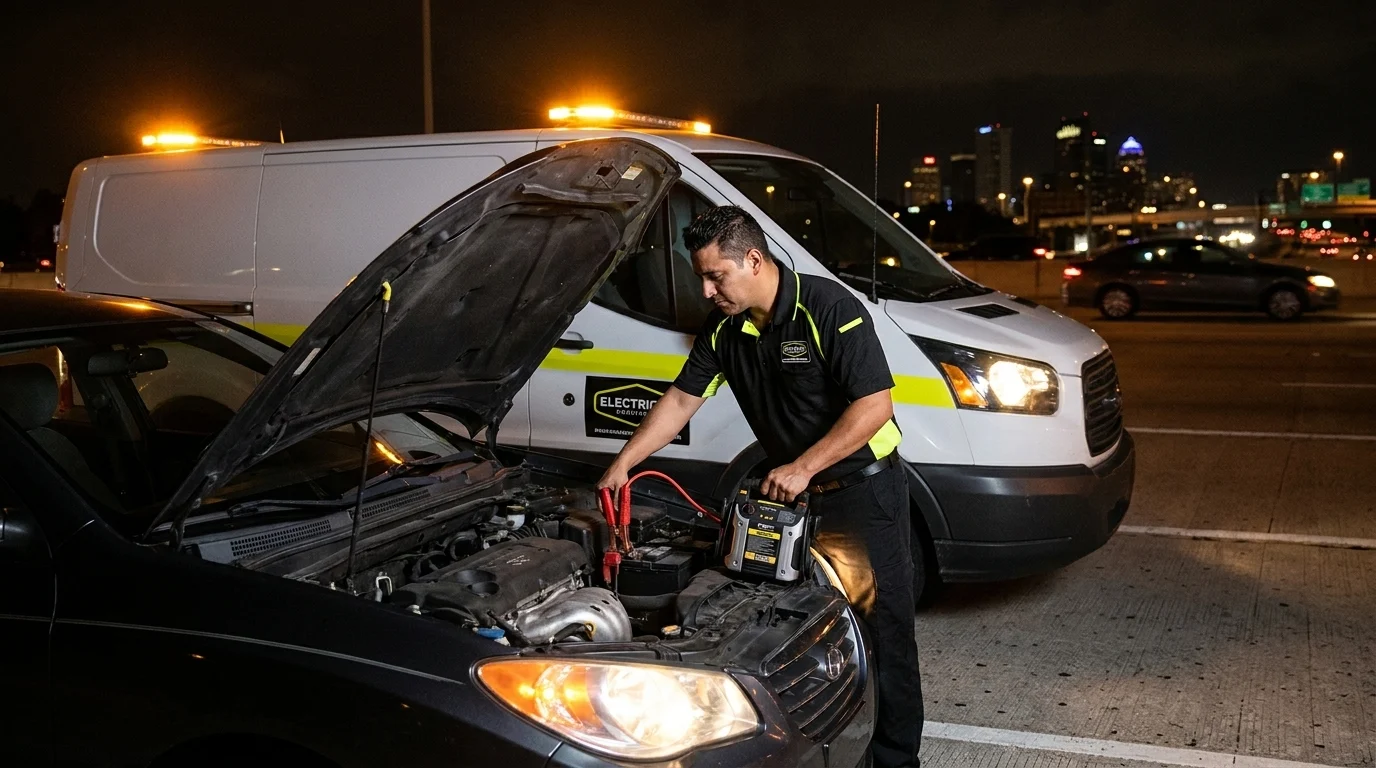
If your battery is three years old or more, it's in the danger zone for Florida. Add a second or third jump start in a month and the picture is clear. A healthy battery that got drained once by a dome light will bounce back after a jump and a good drive. A worn-out battery will keep dying because it can no longer hold a charge.
Not sure which situation you're in? Our breakdown of jump start vs battery replacement walks through how to decide. And if you're curious why batteries here wear out so quickly, see how long a car battery lasts in Florida heat.
How to Confirm a Dying Battery Anywhere in Tampa Bay
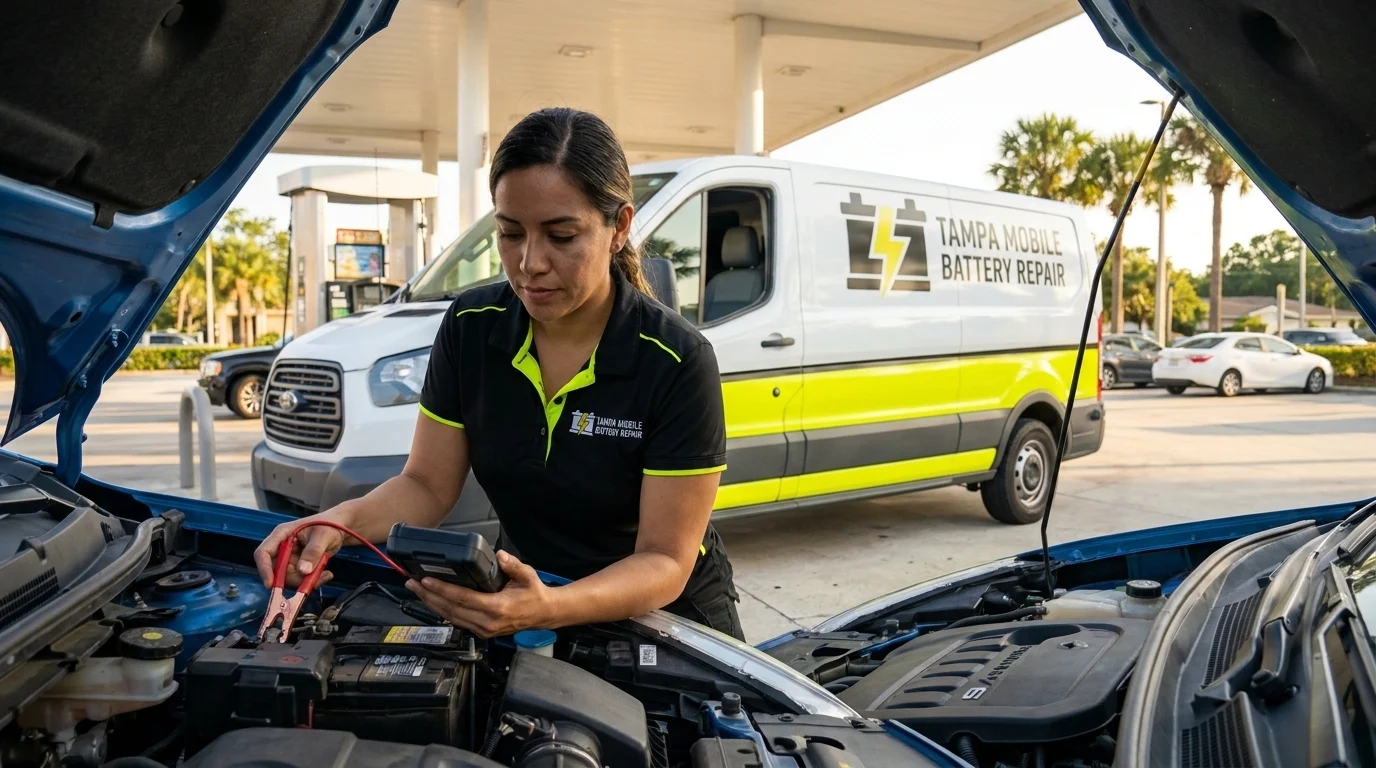
A multimeter gives a rough idea. A fully charged battery at rest reads about 12.6 volts; around 12.4 is partly discharged, and 12.0 or below is close to empty. But voltage alone can fool you, because a worn battery can show decent voltage and still collapse the moment you ask it to crank.
A digital battery tester measures the battery's actual cranking ability against its rating, and a charging-system check confirms the alternator is putting out a healthy charge, typically somewhere around 13.8 to 14.7 volts while running, depending on the vehicle. We run both on every call, at no extra charge, whether we're meeting you at a gas station off SR-60 in Brandon, a driveway in Carrollwood, or an office lot in Lutz. You get a printout of the results, so you know exactly what's wrong before deciding on a battery test only or a full replacement.
The smart move is to act on the first two or three signs instead of waiting for all eight. A weak battery in Florida only gets weaker.