FAQ · 36 Answers · Tampa Bay
Tampa Car Battery FAQ
Dead batteries, jump starts, AGM batteries, prices, warranties, alternators, and Florida heat — answered by the mobile techs who come to you across Hillsborough, Pasco, and Lakeland.
Straight answers to the questions Tampa Bay drivers actually ask us, usually while standing next to a car that will not start. If you do not see your question here, browse our mobile battery services or check whether we cover your neighborhood on the service area page. Every answer below reflects how we really work: 24/7, a firm price on the phone, and a tech who drives to wherever your car is.
Dead Batteries & Jump Starts in Tampa
Most of our calls start with a car that clicks, groans, or does nothing at all, so here is how our 24/7 jump start service handles it.
Rapid clicking almost always means the battery cannot deliver enough current to spin the starter, which points to a weak or drained battery or a loose, corroded terminal. A single loud click with full dash lights can point to the starter instead. Our tech tests the battery, the cable connections, and starter draw on the spot, so you find out which one it is before spending money on parts.
Yes. We run 24 hours a day, every day of the year, and a jump start costs the same at 3 AM as it does at 3 PM. There is no after-hours fee, holiday premium, or fuel surcharge. The dispatcher quotes a firm price when you call, and that is the price you pay when the tech finishes the job.
No. Our techs carry commercial lithium jump packs with surge and reverse-polarity protection, so there is no need for a donor car or borrowed cables. That also means we can reach a car nose-in against a wall, wedged in a tight garage spot, or parked alone on a dark lot where another vehicle could never pull up alongside.
Plan on at least 20 to 30 minutes of steady driving, ideally with some highway time, rather than a short hop across the neighborhood. Idling in the driveway barely charges anything. If the battery is older than about three years or failed our load test, a drive is only a temporary fix, and the next hot morning in Tampa may leave you stranded again.
Two no-starts in one week is a strong sign something is wrong, either a worn out battery, a charging problem, or something draining power overnight. Repeated jumps will not fix any of those. We test the battery and the charging system on every call, and if the battery is done we can usually install a new one from the van right there, with the jump fee credited.
In most cases, yes. When a hybrid or EV will not wake up, the culprit is usually the small 12-volt auxiliary battery that runs the computers and door locks, not the big drive battery. We jump or replace that 12V battery on site. We do not charge or service the high-voltage pack, so if that is the issue we will tell you honestly and point you to the dealer.
Go deeper: Jump Start vs Battery Replacement: How to Know What Your Car Needs in Tampa
Mobile Battery Replacement & Battery Types in Tampa
Here is what to expect when we install a new battery at your car, and how we match the right type. Our AGM vs standard battery guide goes deeper.
That is exactly what we do. A tech brings the correct battery to your driveway, street parking spot, or garage, tests the old one to confirm it is the problem, installs the new one, and checks that the alternator is charging it. You skip the tow, the store line, and lifting a 40-pound battery. We also take the old battery for recycling.
Almost always, yes. Vehicles with automatic engine start-stop are built around AGM or EFB batteries, which handle constant restarts and deep cycling far better than standard flooded batteries. Dropping a cheaper flooded battery into a start-stop car usually leads to warning lights, a disabled start-stop feature, and a short battery life. We match what the manufacturer specifies for your year, make, and model.
A standard flooded battery holds liquid acid and is the economical choice for many older cars. An AGM battery holds its electrolyte in glass mats, resists vibration, recharges faster, and tends to cope better with heavy electrical loads. Neither type is immune to Tampa heat, but if your car came with an AGM from the factory, it should get an AGM replacement.
No. Before the old battery comes out, our tech plugs in a memory saver that keeps power flowing to the car, so your radio stations, clock, seat memory, and the engine computer's learned settings stay put. Some newer European and domestic models also need the new battery registered to the car, which we handle during the visit when your vehicle requires it.
Yes. Batteries tucked under a seat, in the trunk, or behind a fender liner are common on BMW, Mercedes, Audi, and some Chrysler and Dodge models. They take a bit longer, usually 30 to 60 minutes, and the harder access or battery registration may add $25 to $60. The dispatcher tells you that up front so the price is still firm.
Yes, the 12-volt auxiliary battery is something we replace regularly on hybrids and EVs. It powers the computers that let the car turn on, so when it fails the whole car seems dead even with a charged drive battery. We do not work on the high-voltage drive battery itself. Tell the dispatcher your year and model so the right 12V battery is on the van.
Go deeper: AGM vs Standard Car Battery: Which One Belongs in Your Car in Tampa Bay?
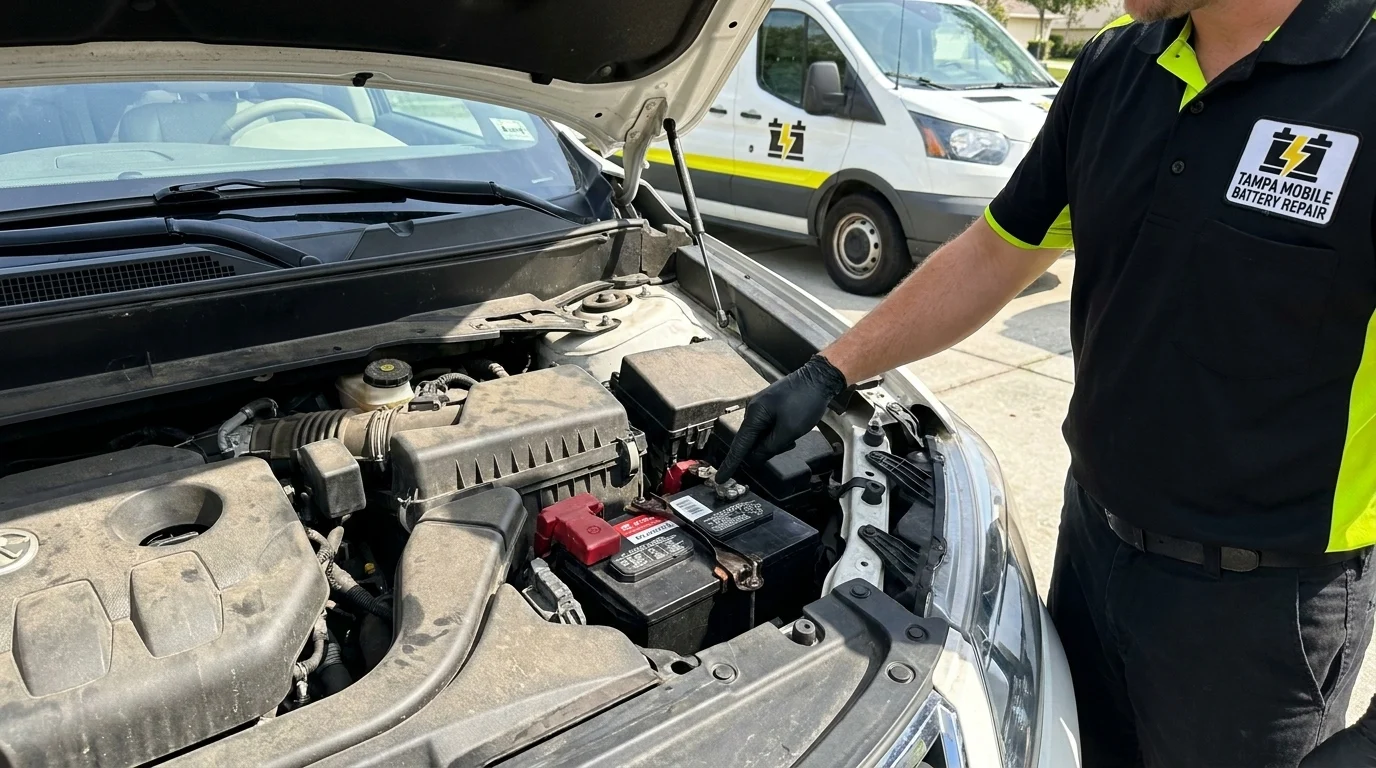 CHECK THE DATE CODE
Pricing, Payment & Warranty for Tampa Battery Service
We quote a firm price on the phone, and our mobile battery replacement cost breakdown explains what drives the numbers.
Most standard batteries run $180 to $290 installed, and AGM or EFB start-stop batteries run $260 to $420 installed. That includes the drive to you, the install, a battery and charging-system test, and recycling the old battery. Under-seat or trunk batteries, or cars needing battery registration, may add $25 to $60. The dispatcher gives you a firm quote before the tech heads out.
The battery itself can cost a little more than a shelf price, but the comparison is rarely that simple. With us there is no tow, no ride to the store, no lifting, no install fee, and no wrestling with corroded clamps in a parking lot. You also get a free test to confirm the battery is actually the problem before you buy anything.
Yes. If we jump your car, the test shows the battery is finished, and you decide to replace it during the same visit, the $65 to $95 jump fee is credited toward the new battery. You only pay the installed battery price. The same goes for our $49 standalone battery test, which is credited if you buy a battery from us.
We take credit and debit cards on site once the work is finished. You get an emailed receipt along with the printout from the battery and charging-system test, which is handy for warranty claims, fleet records, or a reimbursement request from your employer. There is no deposit and no payment before the tech arrives and confirms the job.
New batteries come with a free-replacement warranty, typically two to three years depending on the battery line you choose, plus a 30-day workmanship guarantee on the installation itself. The warranty details travel with your emailed receipt, and our blog has a full guide explaining how prorated and free-replacement coverage differ.
We are an independent, locally run Tampa company, not a motor club or AAA contractor. Anyone can call us directly, whether or not they carry roadside coverage. Some drivers call us when the motor club wait is long or when they want the battery replaced on the spot rather than just jumped. Check with your provider about any reimbursement for outside service.
Go deeper: How Much Does Mobile Battery Replacement Cost in Tampa?
Battery Testing, Alternators & Battery Drain in Tampa
When a battery keeps dying, the real cause is often elsewhere, which is why we offer an alternator and charging-system test on site.
A bad battery usually struggles to start the car but runs fine once it is going. A failing alternator tends to show up while driving: dimming headlights, a battery warning light, flickering gauges, or a car that dies on the road after a jump. Guessing is expensive, so every call includes a free battery and charging-system test that shows which part is failing.
Yes. A standalone on-site battery test is $49, and the fee is credited if the results show you need a battery and you buy one from us. It is a smart move before a road trip, before a long airport stay, or once a battery passes the three-year mark in Florida heat. You get the printout by email either way.
No, we diagnose but do not replace alternators or starters. Our full charging-system diagnosis is $69, and it tells you whether the alternator is charging correctly and whether the starter is pulling too much current. If either part is the problem, we explain the results plainly, make sure your battery is not the weak link, and refer you to a trusted repair shop.
That is what our parasitic drain test is for. We measure how much current the car pulls while it is shut off and asleep, then isolate circuits to track down the source, which is often an aftermarket stereo, dash cam, alarm, trunk or glovebox light, or a module that never powers down. The test runs $95 to $145 depending on how long the hunt takes.
Every modern car draws a small amount of power while parked to keep alarms, keyless entry, and computers alive. A healthy battery can handle that for a while, but an aging battery in Tampa heat may not last a week. An excessive drain can kill even a new battery in days. A test tells you whether it is the battery, the draw, or both.
Absolutely. That crusty white, green, or blue buildup on the posts and clamps adds resistance, so a perfectly good battery cannot push enough current to the starter. Humid, salty air around Tampa Bay speeds corrosion up. Terminal cleaning runs $49 to $79, and badly eaten clamp ends can be replaced for $25 to $45 each, usually during the same visit.
Go deeper: Can a Bad Alternator Drain a Battery? How to Tell in Tampa Bay
Where We Come to You Around Tampa Bay
Home, office, highway shoulder, or long-term lot, we bring roadside dead-battery help to wherever your car happens to be.
Yes, parking decks are routine for us, including downtown, Water Street, Channelside, and Westshore office garages. When you call, tell us the garage, the level, and any posted clearance height so the tech knows where to drive. If the van cannot reach your level, our jump packs and batteries are portable, and the tech will bring everything up to the car.
Yes. We respond to breakdowns on I-275, I-4, I-75, the Selmon Expressway, and the Veterans Expressway. Get as far onto the shoulder as you safely can, turn on your hazards, and stay buckled in or behind the guardrail rather than standing by traffic. Give the dispatcher the direction and the nearest exit or mile marker so the tech finds you quickly.
Yes, cars that sat for a week or two at TIA are one of our most common calls. Tell the dispatcher whether you are in the economy garage or another lot, plus the level and row, and we head straight there. The tech jumps or replaces the battery and tests the charging system, so you can drive home instead of waiting on a tow.
We do. Let the dispatcher know the gate code, call box name, or whether someone needs to buzz us in, plus the building or parking space number. Assigned spots, carports, and tight surface lots are not a problem with portable equipment. If you cannot meet the tech, many complexes let us work with the keys left at the leasing office.
Yes. We get calls from USF student and faculty garages, and from the big lots around Raymond James Stadium after games and concerts. Event traffic can slow our arrival, so we give you a realistic ETA on the phone. Have your lot letter or garage name and a nearby landmark ready, since those lots look identical in the dark.
Yes. Plant City usually sees a tech in about 50 to 65 minutes, and Lakeland in roughly 55 to 75 minutes, both straight out I-4 from our central Tampa dispatch. Wesley Chapel calls typically run 45 to 70 minutes via I-75. Brandon, Apollo Beach, and Sun City Center are closer. These are typical times, so the dispatcher gives you a current estimate based on traffic.
Go deeper: Battery Dead at Tampa Airport Parking? What to Do After You Land
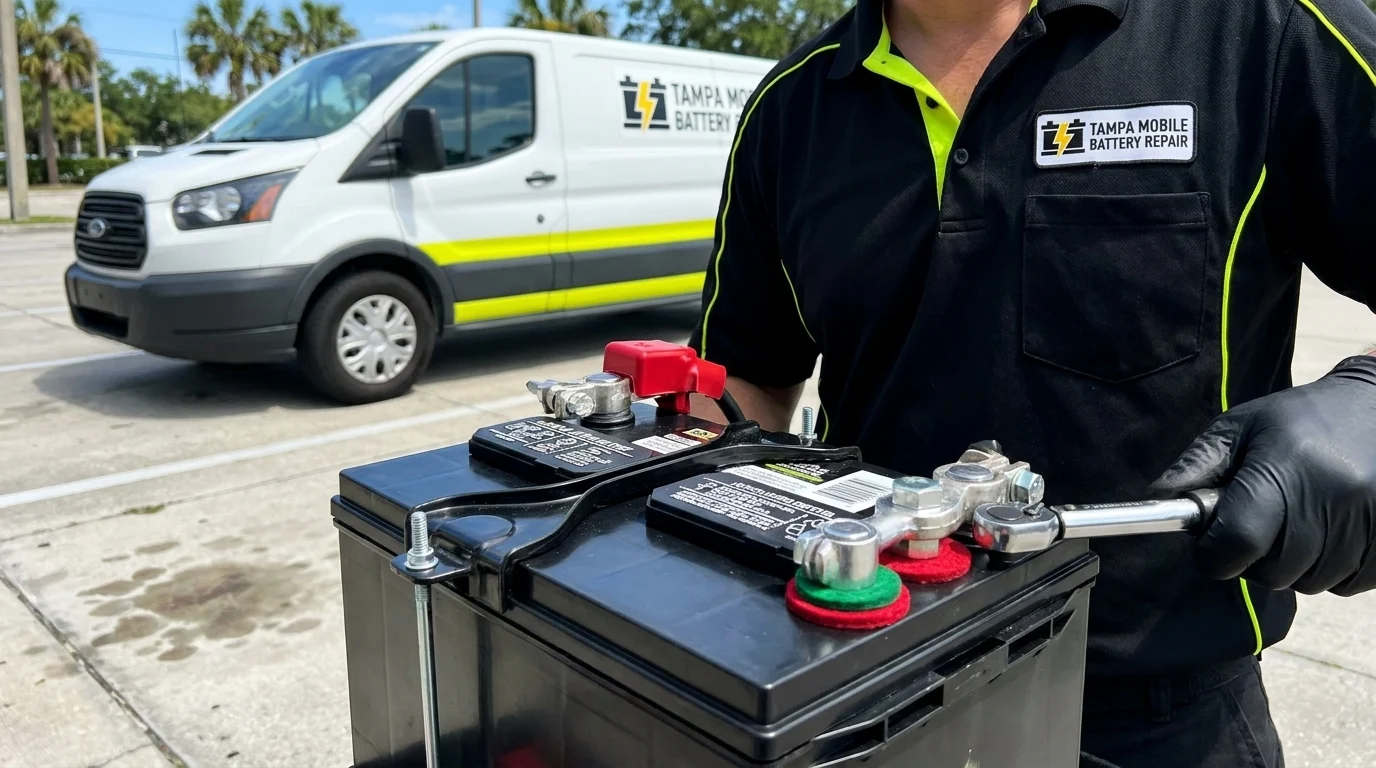 AFTER TERMINAL SERVICE
Florida Heat, Storms & Battery Care in Tampa Bay
Heat, not cold, is what wears out batteries here, and our guide to keeping a battery alive through a Tampa summer has more tips.
In Tampa Bay, most car batteries last about two to four years, which is noticeably shorter than in cooler states. Long stretches of heat under the hood speed up the chemical wear inside the battery and evaporate electrolyte. The damage builds quietly all summer, which is why so many batteries finally give out on the first cool morning in the fall.
Summer heat in Tampa pushes under-hood temperatures far above the air temperature, especially in traffic on I-275 or parked on black asphalt in the afternoon. That heat accelerates corrosion of the internal plates and dries out the battery. Add heavy air conditioning loads and short trips that never fully recharge the battery, and a weak one fails without much warning.
Before a storm, have the battery tested if it is more than three years old, since evacuation traffic is the worst time for a no-start. Fill up, park on higher ground away from flood-prone streets, and keep a phone charger that does not depend on the car. If you leave the car parked for days, disconnecting the negative cable can prevent a slow drain.
Yes, and so can the rest of the electrical system. Do not try to start a car that sat in water above the bottom of the doors, since that can damage the engine and electronics. Have it inspected first. If the water stayed low and the car simply will not start, we can test the battery and connections and tell you whether a battery is the fix.
It helps. A car baking in an open lot all afternoon runs a much hotter engine bay than one parked in a garage, a covered deck, or under shade. Cooler conditions slow the wear inside the battery. Shade will not stop a battery from aging, but over a few Tampa summers it can be the difference between replacing at year two or year four.
Keep the top of the battery clean and dry, make sure the hold-down is tight so it does not vibrate, and check the terminals for corrosion every few months, especially if you live near Tampa Bay or along the Apollo Beach waterfront. Drive at least 20 minutes a couple of times a week. Have it tested once it reaches about three years old, before the summer heat arrives.
Go deeper: How to Keep Your Car Battery From Dying in a Tampa Summer
We Come to You — Wherever You're Stuck
We Come to You Anywhere in Tampa Bay
Most answers end the same way: call, and a tech drives to the car. Here is where we meet drivers most.
- At HomeDriveway, garage, or the curb out front. Keep your morning moving.
- At WorkOffice lots and parking garages, including low-clearance decks downtown and in Westshore.
- Highway ShoulderI-275, I-4, I-75, the Selmon, and the Veterans. Drop a GPS pin and we find you.
- Store & Mall LotsPublix, Target, gyms, and mall lots like International Plaza and Westfield Brandon.
- Airport & Cruise ParkingTampa International garages, park-and-fly lots, and Port Tampa Bay cruise parking.
- Apartments & CondosComplex lots and condo garages. Tell us the building and the space number.
- Schools & CampusUSF, HCC, and school pickup lines, plus boat ramps and park lots on weekends.
- Stadiums & EventsRaymond James Stadium, Amalie Arena, the fairgrounds, and festival parking.
Question
answered?
If the car still won't start, call. We come to you 24/7.
Tap to call · 24/7 · we come to you (813) 590-1783